
SLA 3D Printing for Prototypes: Everything You Need to Know

Prototypes play a vital role in product development, helping engineers and designers evaluate a product's fit, form, and functionality before moving to full-scale production. Among the various 3D printing technologies available, SLA (Stereolithography) printing is widely recognized for its exceptional accuracy, smooth surface finish, and ability to produce highly detailed parts. From concept models and visual prototypes to functional prototypes and engineering components, SLA technology enables faster design validation, reduces development costs, and accelerates product innovation. At Vektor3D Systems LLP, we leverage advanced SLA 3D printing technology to deliver precise, reliable, and high-quality prototypes for a wide range of industrial applications. In this guide, you'll learn how SLA printing works, its key benefits, materials, and applications.
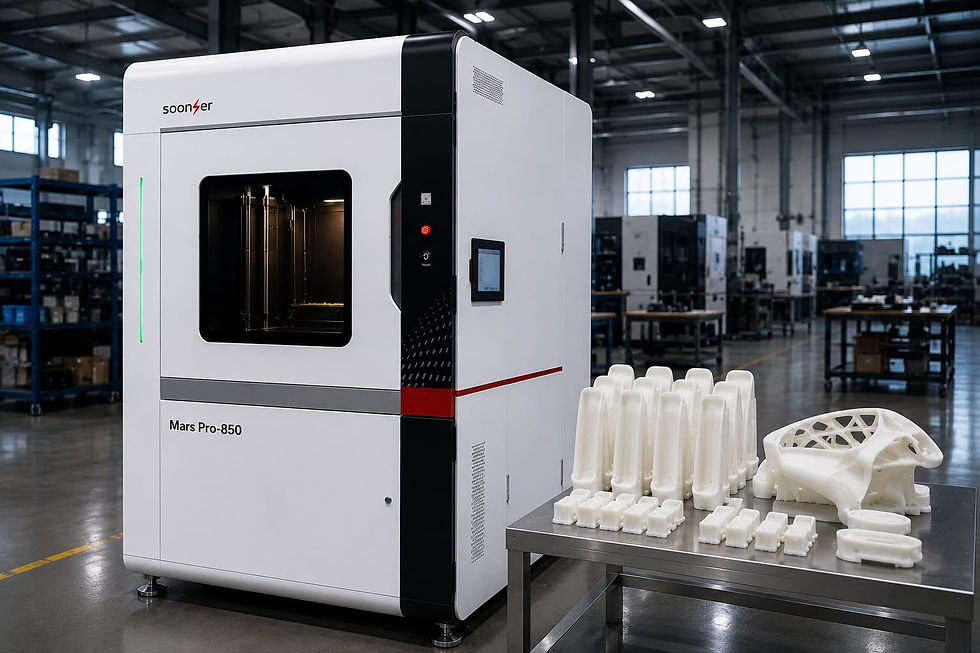
What is SLA 3D Printing?
SLA (Stereolithography) 3D printing is a resin-based 3D printing technology that uses a UV laser to cure liquid photopolymer resin layer by layer, creating highly accurate and detailed parts. As one of the earliest forms of additive manufacturing, SLA is widely used for producing prototypes that require exceptional dimensional accuracy, smooth surface finishes, and intricate geometries.
Unlike FDM printing, which builds parts by extruding melted filament, SLA printing uses liquid resin to achieve finer details and tighter tolerances. This makes it an excellent choice for functional prototypes, concept models, engineering components, and product validation.
Today, SLA 3D printing is widely adopted across industries such as automotive, medical, consumer electronics, and industrial manufacturing, where precision and reliability are critical. With a wide range of engineering resins available—including ABS-like, tough, and high-temperature materials—SLA printing enables businesses to create prototypes that closely resemble the final product in both appearance and performance.
What are Prototypes?
Prototypes are physical models created to evaluate a product's design, dimensions, fit, form, and functionality before full-scale production. They allow engineers and designers to validate concepts, identify potential design issues, and make improvements early in the development process. Depending on the project requirements, prototypes can range from simple concept models and visual prototypes to fit-and-form models, functional prototypes, and engineering validation parts. Using prototypes helps reduce development costs, shorten product development cycles, and improve the quality of the final product.
Benefits of SLA 3D Printing
SLA 3D printing offers several advantages over traditional manufacturing methods and many other 3D printing technologies. Its ability to produce highly accurate, smooth, and detailed parts makes it an ideal choice for concept models, visual prototypes, functional prototypes, engineering components, and low-volume production parts across various industries.
High Precision and Accuracy
SLA 3D printing delivers exceptional dimensional accuracy and fine feature resolution, making it ideal for parts that require tight tolerances and intricate geometries. This level of precision ensures reliable design validation, accurate fit, and consistent performance throughout the product development process.
Smooth Surface Finish
One of the biggest advantages of SLA printing is its outstanding surface quality. Parts are produced with minimal visible layer lines, resulting in a smooth finish that requires less post-processing. This makes SLA an excellent choice for presentation models, product prototypes, and components where aesthetics are important.
Rapid Product Development
SLA enables fast prototyping and quick design iterations, allowing engineers and designers to evaluate concepts, identify potential issues, and refine designs before production. This significantly reduces development time, lowers costs, and helps products reach the market faster.
Wide Range of Engineering Resins
SLA technology supports a variety of engineering-grade resins, including ABS-Like Resin, Tough Resin, High-Temperature Resin, Flexible Resin, and Castable Resin. These materials allow manufacturers to produce prototypes and functional parts with properties tailored to specific testing and application requirements.
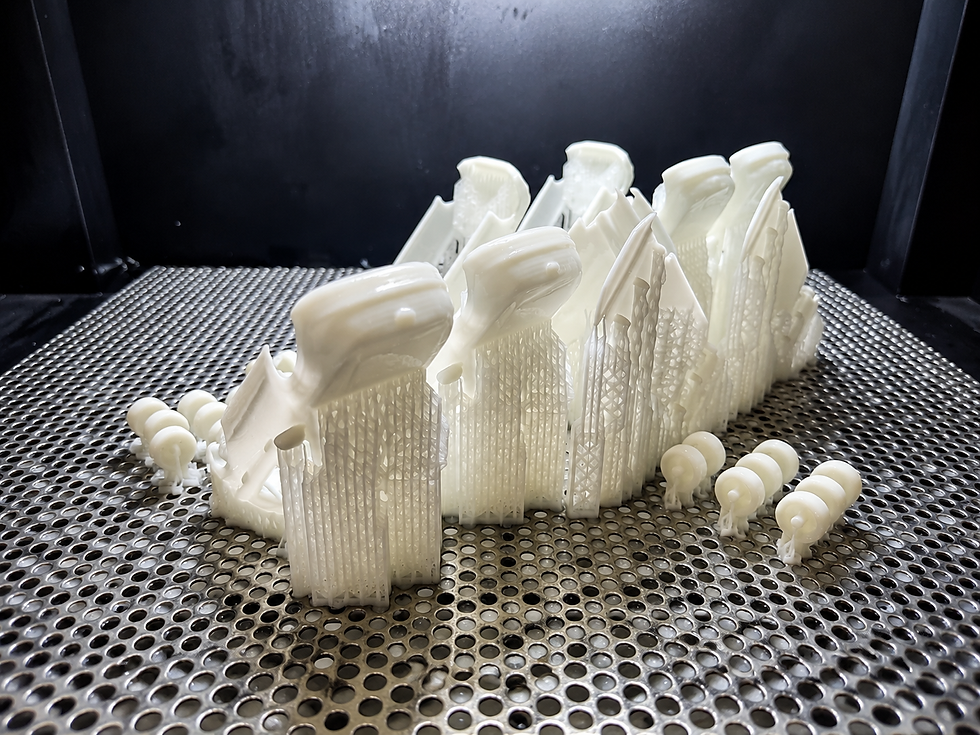
High-precision SLA printed engineering parts with support structures Smooth surface finish of SLA 3D printed functional components
Applications of SLA 3D Printing
SLA 3D printing is widely used across industries where high precision, excellent surface quality, and rapid product development are essential. Its ability to produce detailed prototypes, engineering components, and low-volume production parts makes it a preferred manufacturing solution for designers, engineers, and manufacturers across various sectors.
Medical & Healthcare
SLA printing is used to create surgical guides, anatomical models, dental models, hearing aid components, and medical device prototypes with exceptional accuracy and fine detail.
Automotive
Engineers use SLA technology to produce concept models, dashboard components, sensor housings, air duct prototypes, and functional testing parts, enabling faster design validation before production.
Consumer Electronics
SLA is ideal for manufacturing product enclosures, wearable device prototypes, connectors, casings, and precision components that require a high-quality surface finish.
Industrial Manufacturing
Manufacturers use SLA printing for engineering prototypes, jigs, fixtures, custom tools, assembly aids, and low-volume production parts to improve efficiency and reduce development time.
Aerospace
SLA technology is used to manufacture lightweight components, aerodynamic models, design validation parts, and complex engineering assemblies that require tight tolerances and high dimensional accuracy.
SLA 3D printed decorative prototype with smooth surface finish Highly detailed SLA 3D printed sculpture prototype Highly detailed SLA printed horse prototypes SLA printed automotive prototype for product development
Best Materials for SLA 3D Printing
Selecting the right resin is essential for achieving the desired mechanical properties, surface finish, and performance. Different SLA materials are designed to meet various prototyping and engineering requirements.
ABS-Like Resin
Ideal for engineering prototypes and functional testing, offering excellent strength, durability, and dimensional stability.
High-Temperature Resin
Designed for parts that need to withstand elevated temperatures, making it suitable for automotive, industrial, and tooling applications.
Tough Resin
Provides enhanced impact resistance and durability, making it ideal for engineering components and repeated functional testing.
Transparent/Clear Resin
Perfect for optical prototypes, fluid flow visualization, product enclosures, and applications requiring transparency and fine detail.
Choosing the appropriate resin ensures optimal performance, accuracy, and reliability for your specific application.
Why Choose Vektor3D Systems LLP?
At Vektor3D Systems LLP, we are committed to delivering high-quality SLA 3D printing solutions that combine precision, reliability, and fast turnaround times. Using advanced industrial SLA technology and engineering-grade resins, we manufacture highly accurate prototypes and production-ready components for a wide range of industries. Our experienced team works closely with customers to recommend the right materials, optimize designs, and ensure every part meets the highest standards of dimensional accuracy, surface finish, and performance. Whether you need a single prototype or low-volume production, Vektor3D Systems LLP provides dependable SLA printing solutions tailored to your project requirements.
Ready to Start Your SLA 3D Printing Project?
Contact Vektor3D Systems LLP today to discuss your project and receive a customized quote.
📞 Phone: +91 9082020416
📧 Email: sales@vektor3ds.com
🌐 Website: www.vektor3ds.com


Comments