
From Prototype to Production: How 3D Printing Fits Into Modern Manufacturing

3D printing is no longer limited to prototyping. Today, it is being used throughout product development and manufacturing—from creating initial prototypes and testing designs to producing functional and low-volume parts.
This blog explores how 3D printing supports the journey from prototype to production, helping businesses shorten development cycles, improve design flexibility, and bring products to market more efficiently.
From Idea to Prototype
The journey begins with a digital design, usually created using CAD software. The model is prepared for 3D printing and converted into a suitable file format for the selected printing technology.
A physical prototype can then be produced relatively quickly, allowing designers and engineers to evaluate the shape, dimensions, fit, and overall design of the part.
Instead of relying only on a digital model, teams can hold and inspect a physical representation of the product, identify design issues, and make necessary changes before moving further into development.
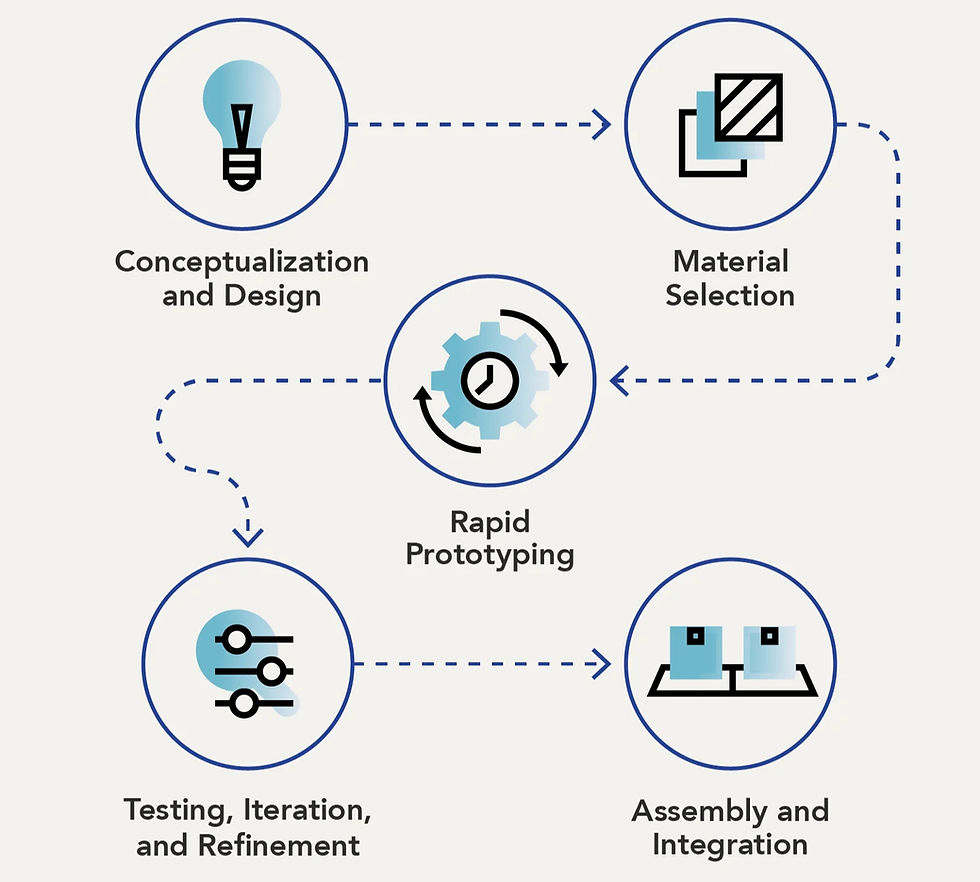
Design Validation & Iteration
After creating the first prototype, engineers can evaluate the part for size, fit, functionality, and overall design. This is especially important for components that need to work with other parts or assemblies.
If any issue is found, the CAD design can be modified and another prototype can be produced without creating new molds or tooling. This allows teams to test multiple design versions quickly and make improvements based on real-world results.
With 3D printing, this design–print–test–modify cycle can be repeated efficiently, helping manufacturers reduce development time and identify potential problems before moving toward final production.
From Prototype to Functional Part
After the design has been validated, the next step is to determine whether the part can perform its intended function.
With the appropriate 3D printing technology and material, parts can be produced for functional testing, assembly trials, fit checks, and performance evaluation. Engineers can assess factors such as strength, movement, dimensional stability, and temperature resistance depending on the application.
This allows manufacturers to test a component in conditions that are closer to its intended use and make further improvements before final production..
From Prototype to Low-Volume Production
Once the design is finalized, 3D printing can also be used for small-batch and low-volume production. This can be particularly useful when production quantities are limited or when creating traditional tooling would require significant time and investment.
Manufacturers can produce customized components, housings, replacement parts, jigs, fixtures, and other specialized products directly from digital designs.
For products that require frequent design changes or customized variations, 3D printing provides the flexibility to move from a validated prototype to production without completely changing the manufacturing approach.
When Is 3D Printing the Right Choice for Manufacturing?
3D printing can be a practical manufacturing solution when flexibility, customization, complex geometries, or shorter lead times are important.
It is particularly suitable for:
Low-volume production
Customized or made-to-order parts
Complex geometries
Replacement and spare parts
Jigs, fixtures, and tooling
Products requiring frequent design changes
Parts that need to be produced on demand
However, 3D printing is not the ideal solution for every manufacturing requirement. For very high production volumes or applications where conventional manufacturing offers a significant cost advantage, processes such as injection molding or CNC machining may be more suitable.
The right choice depends on the part requirements, production quantity, material, performance, and overall cost.
Key Benefits of Using 3D Printing from Prototype to Production
Using 3D printing across different stages of product development can provide several advantages:
Faster development – Produce and evaluate prototypes quickly.
Easy design changes – Modify the digital model without creating new tooling.
Design flexibility – Manufacture complex and customized geometries.
Reduced tooling requirements – Useful for prototypes and low-volume production.
On-demand manufacturing – Produce parts when they are required.
Reduced lead times – Move from design to physical part more efficiently.
Digital inventory – Store designs digitally and reproduce parts when needed.
These advantages make 3D printing a useful part of a flexible and digitally driven manufacturing workflow.
Conclusion
3D printing has evolved from a prototyping technology into a valuable tool for modern product development and manufacturing. From initial prototypes and design validation to functional testing and low-volume production, it can support multiple stages of the product lifecycle.
By selecting the right technology, material, and production approach, businesses can use 3D printing to reduce development time, improve design flexibility, and move from concept to production more efficiently.
Ready to Take Your Product from Prototype to Production?
Whether you need a 3D printed prototype, functional part, or low-volume production, Vektor3D can help you choose the right 3D printing solution for your application.
Discuss your 3D printing requirements with Vektor3D.
📞 Phone: +91 9082020416
📧 Email: sales@vektor3ds.com
🌐 Website: www.vektor3ds.com


Comments